Futures trader and Darwinex Zero evangelist in LATAM, always learning about technical and quantitative analysis with risk management under Hedge Fund standards. Passionate about financial education, discipline, and the meritocratic growth of traders.
Table of Contents
Table of Contents
Disclaimer: The content of this post reflects only my personal experience and opinions based on training processes I went through between 2013 and 2020. It is not intended as an accusation, nor is it meant to damage the reputation of any person or organization. Names, logos, or identifying data have been partially or fully blurred in order to protect the privacy of the individuals involved. This post is educational and reflective in nature, meant to share personal lessons about trading education.
What I’m about to tell you is not to look good or to pretend I’m an “example.” I’m putting this down as an honest record of what happened to me, in case it helps someone else avoid shortcuts that end up costing a fortune. Some parts hurt, some parts are embarrassing; but without that, there is no manifiesto.
You know how it usually starts: ads everywhere. Reels, Shorts, TikTok, YouTube banners… “financial freedom,” “more time for what you love,” “just a phone and 2 hours a day,” “$30 today, $500 tomorrow, $10,000 a month.” The script is perfect because it hits exactly what drives us the most: a strong expectation of fast change + social status.
What they don’t tell you in small print is that this machine is built to capture attention, data, and money, not to build you an actual career. And if you come in without a solid background in statistics or finance, your emotions are in control. That’s why it’s so common for year one to be a fireworks show of losses, and year two to be a show of excuses.
First lesson: the first filter in trading is not technical, it’s psychological 💬. If the message hits your desire before it shows you a method, be suspicious.
2) My chain of mistakes (and why I’m telling you) 📊
#
2.1. Ponzis and “financial freedom” marketing (2013–2017) ⚠️
#
In parallel with my work in IT Support, between 2013 and 2016 I got involved in classic MLM (multi-level marketing) schemes like Amway, Fuxion, WorldGN. In 2017 I fell full victim mode into models that were later publicly flagged as pyramids or Ponzi-type schemes (WeiFastPay, MeCoin, Skyllex, OneCoin, Merlim).
Why did I go in? Because I trusted familiar voices and I didn’t do the homework of checking incentives and structure. Belonging to the group felt more valuable than evidence.
How I see it now: it’s not just “they scammed me.” It’s also that I wanted to believe. And when you’re desperate to believe, you drop every defense 🛑.
Then came the so-called “advanced trading” programs being sold as “institutional trading”: one in-person weekend course, one “private mentorship” online, and one supposedly elite intensive. Tons of slides, tons of technical jargon, and zero real follow-up on my actual learning process.
The in-person program lasted two weekends and ended with three certificates (“expert,” “advanced,” etc.) and a bill close to $1,500, which I even paid in bitcoin. Same story again: very aspirational promises, but no objective metric showing I was actually improving as a trader. Nobody asked for my trading journal, nobody corrected my mistakes live, nobody took responsibility for whether I was understanding or just repeating buzzwords.
The worst part: I invited several friends, because I honestly thought this was going to change our learning curve.
Visual evidence:
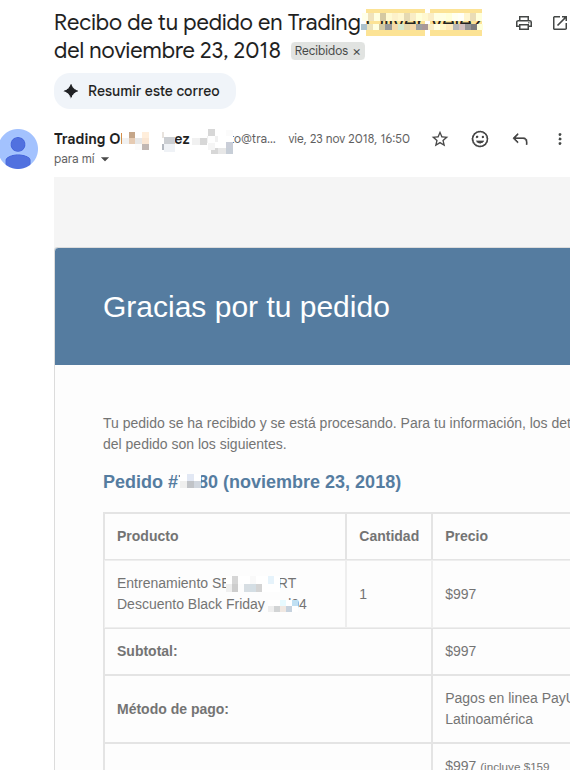
Payment confirmation for a trading training service purchased in 2018. Personal data and third-party names have been edited for privacy.
Certificate issued after completing a two-weekend in-person trading course. Names, signatures, and branding have been blurred.
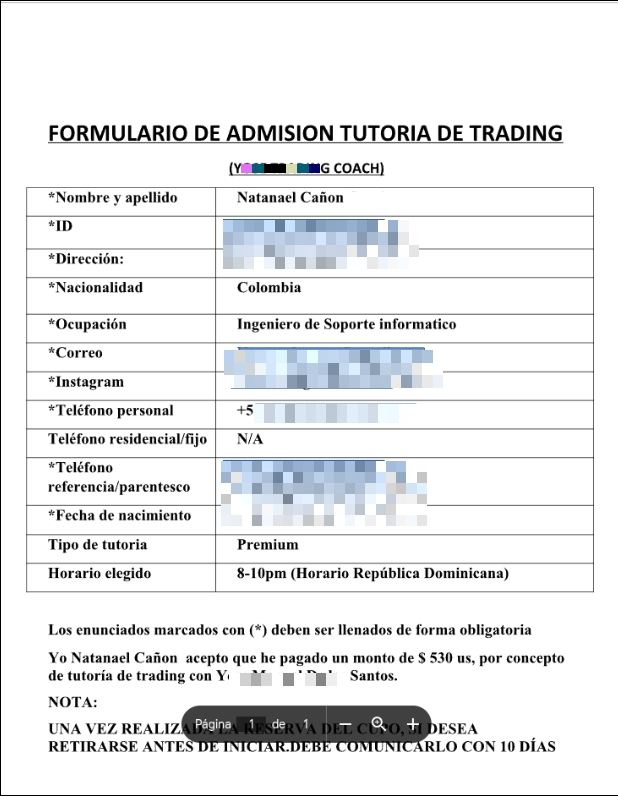
Admission / onboarding form for a one-on-one online mentorship in 2018. Sensitive information has been redacted to protect identities and contact details.
Second lesson:a diploma or a certificate, if it doesn’t come with measurable results, serious performance auditing, and real follow up, is mostly decoration. And in trading, decoration does not build a scalable career 🔍.
3) The mental traps that ran my life (and how I started seeing them) 🧠
#
If someone with “expert” status said it, I followed it. I didn’t stop to ask for evidence, or demand the statistical framework behind what they were selling. The result is you outsource your judgment: you stop thinking and you start obeying.
The group moved and I followed, even if inside I felt the alarm. Phrases like “we’re all in, bro” or “no fear, just size up” melt any sense of caution.
3.3. How did I start getting out of that loop? 🔎
#
By consuming critical content on persuasion and bias. Channels like El Robot de Platón, Ram Talks, Esquizofrenia Natural; interviews with researchers who study Ponzis and coercive persuasion; pulling ideas from Daniel Kahneman’s book Thinking, Fast and Slow; and hours of conversation with my childhood friend Wilmer (a political scientist from UNAL). None of that made me instantly profitable. But it gave me a vaccine: I learned to name the bias before it drags me again.
Third lesson: before you go hunting for the “perfect setup,” learn to spot the bias that keeps you in an endless loop 🔁.
4) The professional mirage: “prop firms” (2019–2020) 🏦
#
In the first wave of so-called “prop firms,” I joined TopStep, Leeloo, E2Trade. I thought: “This is it. From here I go on to manage serious capital, then a real trading floor, then a fund…”
But here’s the reality I ran into:
You can’t transfer those contracts into a real, regulated asset management job.
There are internal rules that shift based on the company’s commercial model (you can’t trade news, no bots, weird ‘consistency rules,’ etc.).
You pay fixed costs just to be allowed to keep playing.
And the critical point: you’re not managing real investor capital under a standardized regulatory framework. You’re trading in their sandbox, with their metrics, aligned with their business incentives, not with professional risk standards.
Fourth lesson: if you can’t carry your performance record to a real investor, under external risk auditing, you’re not building an asset management career, you’re in something that looks more like a Squid Game dressed up as “opportunity” 🎯.
I had to pause. I went back to focusing on IT Support. I never fully stopped studying, but I shifted what I was studying: basic statistics, Bitcoin as a system, and eventually PineScript, which I used to build my own indicators. That distance was essential to reset expectations.
Around that time I found a different kind of podcast: La Hora Alfa (Darwinex) 🎧. They were talking about VaR, risk engines, portfolio construction, correlations, the scientific method, hedge funds, quant systems. At first I probably understood 10% of it. But for the first time I felt the topic was being treated with seriousness. It was something I could confront without emotional bias.
Fifth lesson: learning to trade is not just about fine-tuning entries and exits. Real progress begins when you start reshaping your mental frameworks around risk, statistics, and incentives 🧭.
At that point I stopped asking the usual question: “How do I make more money fast?”, and I started asking the right one: “Who is willing to audit me using professional risk standards and put me in front of real capital, under regulation?”
That question alone eliminates most of the so-called “opportunities” in the industry.
That’s when I found Darwinex Zero, which I initially approached with full skepticism (I had already built an allergy to motivational marketing). Darwinex Zero is essentially a regulated incubation path for traders: your strategy is tracked, risk is monitored externally, and there is a structure designed for investor access.
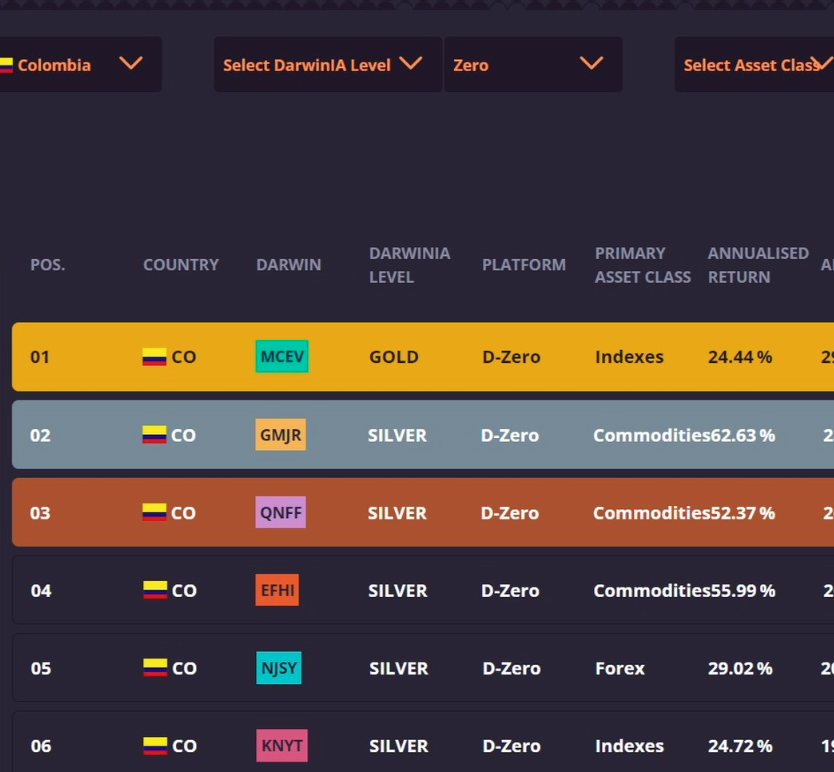
A technical breakdown from Yuri Rabassa pushed me to actually analyze it instead of dismissing it. I opened my first DARWIN (MCEV). And here’s what changed for me:
Audited track record: performance is tracked by a regulated asset manager 🧰.
Risk metrics: position sizing and exposure are monitored and standardized 📊.
Real investor interest: you’re not just “passing a challenge,” you’re becoming something investors could allocate to 🤝.
I became (to my knowledge) the first Colombian to reach DarwinIA Gold (roughly +20% in just over 8 months). Over 23 months, I was able to leverage the equivalent of 400x every dollar of my subscription (I’ll detail this later under something I call the Capital Efficiency Ratio – CER).
And even then, I decided to shut it down.
Why would I shut it down if it was “working”? Because I felt it still depended on too many moving parts that weren’t yet anchored to my own standards. I didn’t feel comfortable seeing investors show up to something that I myself didn’t yet feel was ready to scale responsibly.
So I rebuilt the whole thing and launched LSPR: stronger aversion to loss, tighter risk control, more conservative VaR, clear and trackable rules.
Today I can say this with peace of mind: I don’t run multiple hidden accounts, I don’t reset accounts, I don’t chase lottery trades. I trade with a focus on process, metrics, and regulated scalability, under frameworks aligned with supervision from bodies like CNMV, ESMA, or FCA 🧪.
The logic is similar to a mini investable ETF: a DARWIN is like a wrapped version of a trading strategy that investors can allocate to. The risk engine caps investor risk (for example, around a 6.5% maximum), so the strategy can sit next to other ETFs and, for Darwinex, even next to other hedge funds.
Sixth lesson: sometimes responsibility means stopping something that “works” just because it doesn’t pass your own standard for ethics, transparency, and risk 🎯.
7) The core of all this: risk as the base metric 📌
#
Here’s the center of everything. Without risk management, all trading talk is just storytelling after the fact.
My pillars now:
VaR (Value at Risk): a way to estimate potential damage under normal market conditions, in money terms, before things get ugly.
Transparency: attract investors mainly through a single, auditable track record. A “new account” is only justified if it’s truly uncorrelated with the first.
Statistical consistency: defined entries, defined exits, falsifiable hypotheses, and a sample size that actually means something.
Seventh lesson: anyone can throw metrics in an Excel table. That’s fine as a first step. But the real iceberg, the behavioral pattern of the strategy only shows up when a regulated asset manager is watching your risk and your consistency.
8) What I wish someone had told me in the beginning 📝
#
Check incentives. If someone profits when you “pass,” but does not share real financial risk with you, pay attention.
Demand external auditing. If there’s no regulated third party validating both risk and performance, you’re not as “professional” as you think.
Measure before you believe. Put VaR ahead of other people’s motivational stories. Stories inspire, but metrics govern. (Go read chapter 11 of Homo Deus.)
Process beats lucky results. A method that is repeatable and falsifiable is worth far more than one perfect month.
Regulation matters. It’s not “bureaucracy.” It’s the framework that makes your career defensible and scalable.
Operational humility. The market doesn’t owe you anything. Your job is to limit damage and earn the right to keep going.
Radical transparency. If you can’t explain it, measure it, and show it, don’t sell it.
I operate with a focus on risk, traceability, and method.
And, since 2024, I’ve also worked with Darwinex Zero (in business development for LATAM), speaking directly with traders, mentors, and academies in one-on-one calls (no cost). We talk about risk, traceability, and how to build something that can live under a regulated umbrella instead of just spinning on hope.
There is a path to professionalize yourself without falling into the promise machine. I don’t sell shortcuts or adrenaline hits. What I try to offer is clarity of criteria: statistics, rules, limits, and a common language with real investors.
Eighth lesson: if you want trading to be your profession, spend less energy on “fancy entries” and more on structures that can survive any audit.
I don’t “live off trading” yet. But I take inspiration from people who’ve done it for decades, and whose audited track records any of us can actually look at 🧾.
10) Why this manifiesto is the first post on my blog 🧭
#
This manifiesto opens my blog because I want everything I publish from here on to start from this point: continuous learning, transparency, and respect for regulation.
I want to share tools I’ve built, how I see this industry, where I’ve failed and where I’ve improved, and I want real feedback from people who bring rigor and constructive intent.
When I drift, I want to come back to this text and remember why I started again 🔄.
VaR (Value at Risk)
A statistical measure widely used in hedge funds. It estimates how much a trading account or portfolio could lose under normal market conditions over a certain time period, with a certain probability. In plain language: “How much damage can I reasonably expect before things get critical?”
Risk engine
An automated system that limits the trader’s exposure in order to protect the investor. Think of it like a seatbelt: if risk goes above allowed limits, it cuts size or exits positions, even if the trade was winning. Its job is not to “save the trade,” it’s to cap maximum allowed loss.
Audited track record
A performance history verified by a regulated entity or independent third party. It’s not just a screenshot of your terminal and it’s not an Excel sheet. It’s a validated record where the metrics cannot be altered.
Prop firm
A legitimate proprietary trading firm is a company that puts its own capital at risk and lets traders operate within its infrastructure under internal risk supervision. However, many companies that sell “challenges” or “evaluations” market themselves as prop firms without actually functioning that way. In those models, the trader pays to “qualify,” but in most cases they are not truly managing regulated investor capital. They operate under internal rules defined by the company (sometimes shifting) and metrics optimized for the company’s commercial interests, not necessarily for professional risk management standards.
Regulated asset manager
An entity supervised by official bodies (CNMV, FCA, SEC, ESMA, etc.) that manages third-party capital under investor protection rules.
DARWIN / DarwinIA
Products within the Darwinex ecosystem. A DARWIN is an investable asset that mirrors a trader’s strategy but with standardized and controlled risk. DarwinIA is an internal allocation program that channels investor attention and capital toward the most consistent DARWINs based on performance and risk metrics.
Hedge fund
A private investment fund that actively manages strategies with strict risk control to generate risk-adjusted returns. It’s professional capital management with continuous oversight.
ETF (Exchange-Traded Fund)
A fund that trades on an exchange and tracks a basket of assets or an index. In this manifiesto, I use it as an analogy: a DARWIN behaves like a “mini investable ETF” tied to a trader’s strategy, but with the risk constrained by an external risk engine.
Capital Efficiency Ratio (CER)
A way I use to summarize how effectively each dollar is being leveraged without blowing up my overall risk or the money I’m putting into the process.
PineScript
The scripting language in TradingView used to build custom indicators and strategies. For me, it was one of the first tools that helped me stop depending on other people’s narratives and start measuring things myself.
MLM (multi-level marketing)
A sales structure where you earn not only from selling products, but also from recruiting new sellers. In my story, MLM was the door to promises of “passive income” that emotionally sold belonging more than they provided financial evidence.
Cognitive biases
Mental shortcuts that distort judgment (authority bias, herd behavior, optimism bias, etc.). In trading, naming your biases is usually the first real step in stopping yourself from justifying every loss.
Falsifiability
A basic principle of the scientific method: an idea only counts as serious if it can be tested, and, if it fails, rejected. In trading, that means your strategy needs rules clear enough that you can say, “This stopped being valid.”
External audit
A review by an independent third party that confirms your stated performance and your stated risk actually match reality. Without external audit, everything is just trust.